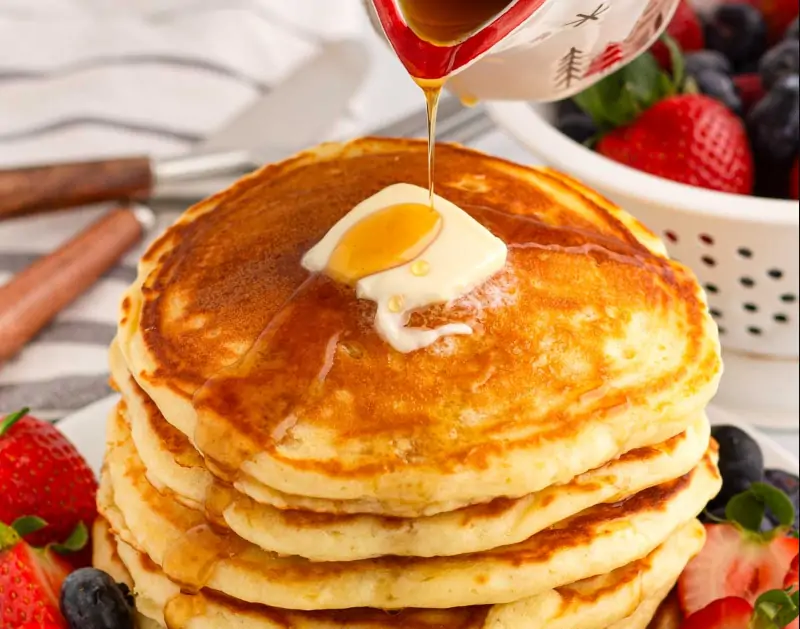
Flat pancakes are almost always a mixing problem, not a recipe problem. Flour develops gluten the moment it meets liquid, and every extra stir past the point where the flour disappears trades height for chewiness. The batter should look wrong when you stop, lumpy and a bit shaggy.
The other half of the answer is buttermilk. Its acidity reacts with the baking soda to make carbon dioxide, and that reaction starts the second they meet, which is why the batter rests for five minutes and then goes straight into the pan.
Why This Recipe Works
- Genuinely tall pancakes, roughly half an inch each, without whipping egg whites.
- Twenty minutes from flour to plate.
- The batter is mixed by hand in one bowl. No mixer.
- Freezes well, so a double batch covers school mornings for two weeks.
Ingredients You’ll Need
- 2 cups all-purpose flour — spooned into the cup and levelled. Scooping packs in up to 20 percent extra flour and makes dense pancakes.
- 2 tablespoons granulated sugar
- 2 teaspoons baking powder
- 1 teaspoon baking soda — this is what reacts with the buttermilk. It is not interchangeable with baking powder.
- 3/4 teaspoon kosher salt
- 2 cups buttermilk — real buttermilk gives the best rise and tang.
- 2 large eggs — at room temperature.
- 4 tablespoons unsalted butter, melted and cooled slightly — hot butter will scramble the eggs.
- 1 teaspoon vanilla extract
Substitutions and Variations
- No buttermilk: stir 2 tablespoons of white vinegar or lemon juice into 2 cups of milk and leave it for 10 minutes. It is not quite as good but it works.
- Dairy free: unsweetened almond milk with vinegar, and oil in place of the butter.
- Blueberry pancakes: scatter berries onto each pancake once it is in the pan rather than stirring them through the batter, which turns it grey.
- Whole wheat: replace up to half the flour. Beyond that they get heavy.
- Extra tang: replace 1/4 cup of the buttermilk with sour cream.
How to Make Fluffy Buttermilk Pancakes
- Mix the dry ingredients. Whisk the flour, sugar, baking powder, baking soda and salt together in a large bowl.
- Mix the wet ingredients. In a second bowl, whisk the buttermilk, eggs, melted butter and vanilla until combined.
- Combine gently. Pour the wet into the dry and fold with a spatula only until no dry flour is visible. Around 10 to 12 strokes. The batter must still be lumpy.
- Rest the batter. Leave the bowl alone for 5 minutes. The flour hydrates and the leavening starts working, which is where a lot of the height comes from.
- Heat the pan. Set a nonstick skillet or griddle over medium-low and let it come up to temperature for 3 minutes. A drop of water should sizzle and skip, not vanish instantly.
- Cook. Pour 1/4 cup of batter per pancake. Cook for about 2 minutes, until bubbles form on the surface and the edges look set and dry, then flip once and give it 1 to 2 minutes more.
- Keep warm. Hold finished pancakes in a single layer on a rack in a 200F oven. Stacking them traps steam and softens the outside.
Expert Tips
- Lumps are correct. A smooth batter means the gluten is developed and the pancakes will be flat and chewy.
- Medium-low, not medium-high. Too hot and the outside browns in 40 seconds while the middle stays raw batter.
- Flip once. Every additional flip presses out air you spent effort creating.
- Wipe the pan between batches. Accumulated butter burns and gives later pancakes a speckled, bitter crust.
- Measure flour by weight if you can. 240 grams for the 2 cups. This is the single change that made my pancakes consistent.
Storage and Reheating
- Fridge: 3 days, stacked with parchment between them.
- Freezer: 2 months. Freeze flat on a tray first, then bag them, so they do not fuse together.
- Reheating: toaster on a low setting is the best method by a wide margin. Oven at 350F for 8 minutes for a large batch.
- Batter: do not store it. The leavening is spent within about 30 minutes.
Frequently Asked Questions
Why are my pancakes flat?
Usually overmixing, which develops gluten and knocks out air. Stop folding while the batter is still lumpy. The other common cause is old baking soda, which loses power after about six months once opened.
Can I make the batter the night before?
It is better not to. Buttermilk and baking soda react immediately, so by morning the lift is gone and the pancakes come out dense. You can measure the dry mix the night before and combine in the morning.
What if I only have baking powder?
Use 3 teaspoons of baking powder total and leave out the soda, but expect slightly less rise and less tang. The soda is what neutralises the buttermilk acid.
How do I know when to flip?
Bubbles appear across the surface and the edges lose their glossy wet look. If you flip while the edges still look shiny, the pancake will deflate.
Can I double the recipe?
Yes, and it scales cleanly. Mix in one large bowl and still fold minimally. Cook in batches rather than crowding the griddle.
Recipe Card
Fluffy Buttermilk Pancakes
By Simon Ab · Breakfast · American
Ingredients
- 2 cups all-purpose flour
- 2 tablespoons granulated sugar
- 2 teaspoons baking powder
- 1 teaspoon baking soda
- 3/4 teaspoon kosher salt
- 2 cups buttermilk
- 2 large eggs
- 4 tablespoons unsalted butter, melted and cooled slightly
- 1 teaspoon vanilla extract
Instructions
- Mix the dry ingredients. Whisk the flour, sugar, baking powder, baking soda and salt together in a large bowl.
- Mix the wet ingredients. In a second bowl, whisk the buttermilk, eggs, melted butter and vanilla until combined.
- Combine gently. Pour the wet into the dry and fold with a spatula only until no dry flour is visible. Around 10 to 12 strokes. The batter must still be lumpy.
- Rest the batter. Leave the bowl alone for 5 minutes. The flour hydrates and the leavening starts working, which is where a lot of the height comes from.
- Heat the pan. Set a nonstick skillet or griddle over medium-low and let it come up to temperature for 3 minutes. A drop of water should sizzle and skip, not vanish instantly.
- Cook. Pour 1/4 cup of batter per pancake. Cook for about 2 minutes, until bubbles form on the surface and the edges look set and dry, then flip once and give it 1 to 2 minutes more.
- Keep warm. Hold finished pancakes in a single layer on a rack in a 200F oven. Stacking them traps steam and softens the outside.
Nutrition per serving (estimate): 168 kcal · 5g protein · 23g carbohydrate · 6g fat. These values are calculated automatically and are provided as a guide only. See our disclaimer.